BBC star Lord Sugar calls for Royal Navy to stop asylum seekers getting to UK . hyn

The star of The Apprentice outlines what his priorities would be as prime minister.

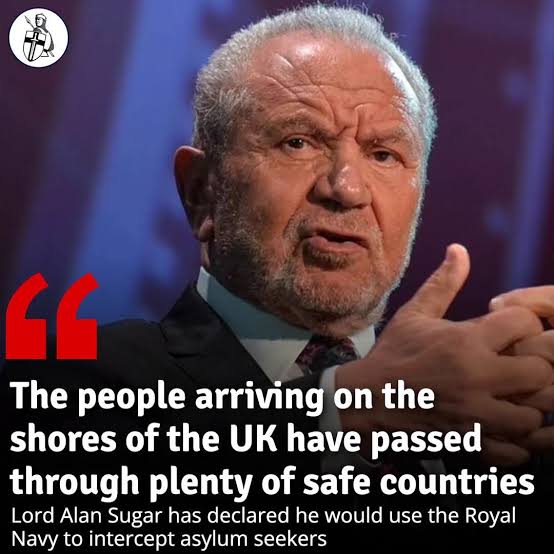
Lord Sugar says he would use the Royal Navy to intercept migrants on small boats (Image: Getty)
Lord Alan Sugar has said he would ask the Royal Navy to stop asylum seekers arriving on small boats if he were prime minister. The star of the BBC series The Apprentice included the idea in a list of his priorities in response to requests from fans to outline what he would do if he were in charge of the country.
Top of his list is building five, large “modern-day” prisons as well as recruiting 10,000 more police and prison officers, paid for by cutting back on military spending. The crossbench peer detailed his final priority by writing on X: “My understanding of asylum seekers is that if they are trying to leave an oppressed county where they are in danger, they are supposed to go to nearest safe county (sic). “The people arriving on the shores of the UK have passed through plenty of safe countries. I would ask the Royal Navy to stop them arriving.”
Lord Sugar‘s immigration priority was welcomed by many of his followers, but quite a few disagreed with his military spending proposal. Some cautioned him to be careful in case critics labelled his “far right”. The entrepreneur’s understanding of where people should first claim asylum also differs from international law.
This does not say refugees have to claim asylum in the first safe country they arrive at. People fleeing persecution can seek asylum in any country which is a signatory to the 1951 United Nations Convention Relating to the Status of Refugees. Lord Sugar may have been thinking of EU regulations, which state that a country inside the bloc can return an adult asylum seeker to the first European country they reached.
His support for using the Royal Navy to intercept migrant vessels is similar to Reform UK’s “Operation Fortress” proposal, which would involve using navy offshore patrol vessels instead of Border Force to “shadow” dinghies.

Migrants would then be escorted to France or Belgium in what Reform UK leader Nigel Farage has described as the largest military operation in the English Channel since the Second World War.
Under former prime minister Boris Johnson‘s Government, the UK launched Operation Isotrope, which included plans for “pushbacks”. But the plan to force small boats to turn back to France was abandoned amid concerns it would be dangerous and could result in legal action against navy personnel.
A founding principle of maritime law is that mariners must rescue anyone in distress at sea. Mr Farage argues his plan is not “pushback”, but involves rescuing and returning Channel migrants.
Reform UK’s home affairs spokesman, Zia Yusuf, said if France refused to accept the returns, marines would take them back regardless. Experts have warned that such moves would be illegal and cause a diplomatic row between the UK and France.
A Government minister said such a policy would result in a lot of arguing between London and Paris with nothing much getting done to actually solve the problem. Energy Secretary Miatta Fahnbulleh told the BBC the Government’s action against people smuggling gangs was working and the idea was “gimmicky”.
BBC Star Lord Sugar Calls for Royal Navy to Stop Asylum Seekers Getting to UK
Lord Alan Sugar has reignited the debate over Britain’s response to small-boat crossings after saying that, if he were prime minister, he would ask the Royal Navy to stop asylum seekers arriving in the UK by sea.
The businessman and star of the BBC programme The Apprentice made the comments while responding on X to people asking what his priorities would be if he were running the country. His proposals covered prisons, policing, defence spending and immigration, with the role of the Royal Navy in the English Channel becoming the most politically controversial part of his intervention.
Lord Sugar’s comments have attracted both support and criticism, highlighting how contentious the small-boats issue remains. Supporters of tougher border controls have argued that Britain needs a more decisive response, while critics have questioned the practicality, safety and legality of using military vessels to prevent asylum seekers from reaching British territory.
At the heart of the dispute is a difficult question: how far should the UK go in using state power to prevent irregular Channel crossings while still complying with international law and its obligations towards people seeking protection?
Lord Sugar’s proposed priorities
Lord Sugar did not present his Royal Navy proposal in isolation. He outlined a wider programme that he said he would pursue if he became prime minister.
Among his priorities would be the construction of five large modern prisons and the recruitment of 10,000 additional police officers. He also proposed recruiting more prison officers and increasing their professional status.
Interestingly, Lord Sugar suggested that some of the money for these measures could be found by reducing military expenditure. He even proposed that soldiers could be given the opportunity to move into police or prison officer roles.
It was in this context that he addressed immigration.
Lord Sugar said he believed people fleeing dangerous or oppressive countries should seek safety in nearby safe countries. He then argued that many people arriving in Britain by small boats had travelled through other countries before reaching the English Channel.
His conclusion was that, if he were prime minister, he would ask the Royal Navy to stop the boats arriving.
The proposal immediately raised questions about how such a policy could actually work at sea.
The legal question over asylum
One of the most important aspects of the controversy concerns Lord Sugar’s suggestion that asylum seekers should seek protection in the nearest safe country.
That is not a general requirement under international refugee law.
The 1951 Refugee Convention does not establish a universal rule stating that a person fleeing persecution must claim asylum in the first safe country they reach. People can seek asylum in countries that are parties to the relevant international agreements, although individual states may have specific arrangements concerning responsibility for asylum claims and the transfer of applicants between countries.
This distinction matters because preventing a small boat from reaching Britain is not simply an immigration-policy decision. It can also involve maritime law, refugee protection and the legal responsibilities of personnel operating at sea.
Any government seeking to implement such a policy would therefore have to establish precisely what naval personnel were authorised to do.
The challenge of stopping boats at sea
The English Channel is one of the world’s busiest shipping lanes. Small inflatable boats carrying migrants can be vulnerable to strong currents, changing weather and heavy commercial traffic.
This creates a fundamental operational problem.
A vessel attempting to intercept a small boat cannot simply treat it as an ordinary border-control operation. If people are in distress, maritime authorities have responsibilities to protect life.
That is why proposals involving interception or “pushbacks” have attracted considerable scrutiny.
The UK previously considered measures involving the forced turnback of small boats under the former Conservative government. Plans associated with Operation Isotrope were abandoned amid concerns about safety and the possibility of legal action against personnel involved.
The experience illustrates why the issue is considerably more complicated than simply deploying a larger vessel.
A Royal Navy ship could potentially locate or shadow a small boat, but deciding what happens next would be the crucial question.
Would the passengers be rescued? Would they be transferred to another vessel? Could they be returned to France? What would happen if France refused to accept them?
Each scenario carries different legal and diplomatic implications.
Similarities with Reform UK’s proposal
Lord Sugar’s suggestion also bears similarities to proposals previously associated with Reform UK.
The party has promoted an approach involving Royal Navy offshore patrol vessels being used to shadow small boats. The proposal has been described as a major military operation intended to prevent migrants from completing the journey to Britain.
Nigel Farage has argued that vessels intercepted in the Channel could be taken towards France or Belgium rather than being allowed to continue towards British shores.
Reform representatives have argued that such an approach should be distinguished from simply forcing boats to turn around. However, the practical difference between interception, rescue, escorting and returning people remains a matter of considerable debate.
The comparison is politically significant because it places Lord Sugar’s comments within a wider argument about whether the military should have a greater role in border enforcement.
Supporters want stronger action
Those supporting Lord Sugar’s position are likely to focus on the continuing political pressure created by small-boat crossings.
The issue has become one of the most visible symbols of Britain’s immigration debate. Governments have repeatedly promised to tackle people-smuggling gangs and reduce dangerous journeys across the Channel.
Supporters of a stronger approach argue that smugglers exploit vulnerable people by placing them in unseaworthy boats. They maintain that disrupting the business model could reduce the incentive for people to make the crossing.
From this perspective, a more visible naval presence could be presented as part of a wider deterrence strategy.
However, supporters would still need to answer difficult questions about what happens to people intercepted at sea and whether proposed returns can legally and practically be carried out.
Critics question the military approach
Critics argue that involving the Royal Navy could create problems without necessarily resolving the underlying causes of the crossings.
The Navy’s primary responsibilities concern national defence and maritime security. Using military resources for immigration enforcement could require substantial planning, personnel and funding.
There is also a question of priorities.
Lord Sugar himself suggested reducing military spending to finance additional policing and prisons. Critics could therefore question whether using the Royal Navy for Channel operations fits comfortably with a proposal that simultaneously seeks to reduce defence expenditure.
The government has also faced pressure to demonstrate that its approach to tackling people-smuggling networks is effective. Energy Secretary Miatta Fahnbulleh has criticised the idea of using the military in this way as “gimmicky”, arguing that government action against smuggling gangs was already making progress.
That reflects a broader disagreement over where the emphasis should lie: at sea, at the border, in France and other European countries, or through criminal investigations targeting the organisers of smuggling networks.
France remains central to the debate
Whatever policy Britain chooses, France is likely to remain an essential part of the discussion.
The Channel is a shared maritime environment, and any attempt to return people intercepted at sea would raise questions about whether French authorities would accept them.
A unilateral British policy could therefore produce diplomatic tensions.
Previous proposals have already generated warnings that forcing returns without French agreement could result in disputes between London and Paris.
This means that a successful strategy would probably require cooperation as well as enforcement.
Britain could seek agreements covering the return of people who have no legal right to remain in the UK, while simultaneously expanding legal routes for those who genuinely require international protection.
The bigger immigration debate
Lord Sugar’s intervention has also reopened a wider question about what Britain expects from its immigration system.
The country faces competing pressures. Governments want effective border control, while asylum law requires applications to be assessed and people with legitimate claims to protection to receive appropriate consideration.
There is also a humanitarian dimension.
Some people crossing the Channel may have travelled through several countries before reaching Britain, but their individual circumstances can vary considerably. Determining whether someone qualifies for protection is therefore different from simply determining how many borders they have crossed.
That distinction will remain important regardless of which political party is in government.
A debate likely to continue
Lord Sugar’s proposal is unlikely to settle the argument. Instead, it has highlighted the competing priorities surrounding Channel crossings: border control, national sovereignty, maritime safety, international law, defence resources and relations with France.
His comments also demonstrate how immigration policy has moved beyond Westminster and into wider public debate. As a prominent broadcaster and businessman, Lord Sugar has a large public platform, meaning his intervention is likely to attract attention well beyond traditional political circles.
For supporters, the proposal represents a call for tougher action against a system they believe has failed to prevent dangerous small-boat journeys.
For critics, it raises questions about legality, safety and whether military intervention would address the underlying causes of irregular migration.
The central challenge for any government will be finding a policy that can control the border without creating new legal, diplomatic or humanitarian problems.
Lord Sugar has made his position clear: he believes the Royal Navy should play a role in stopping asylum seekers from reaching Britain.
Whether such a policy could actually be implemented would depend on far more than political will. It would require detailed rules for naval personnel, cooperation with neighbouring countries, compliance with maritime and refugee law, and a clear plan for what happens to people intercepted at sea.
The argument over small boats is therefore unlikely to disappear. If anything, Lord Sugar’s intervention shows that Britain’s debate over immigration and border control is entering another phase—one in which the question is no longer simply how to reduce crossings, but how far the country is prepared to go to prevent them.