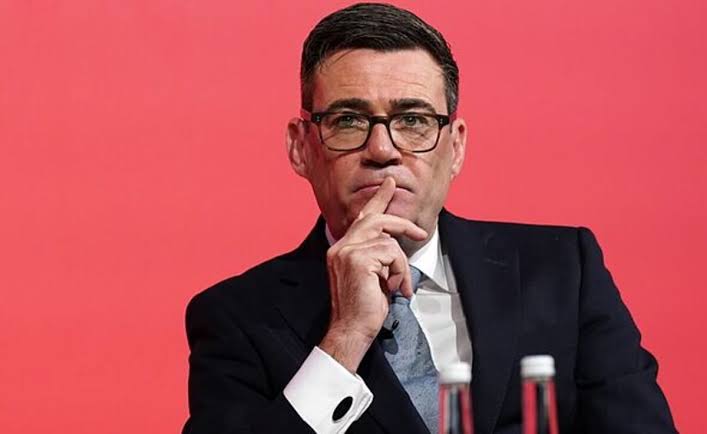

Andy Burnham Dealt Brexit Blow as Bombshell Poll Tears Apart His EU Plan
Andy Burnham’s decision to reopen the debate over Britain’s long-term relationship with the European Union has triggered a fresh political storm, with a new poll highlighting the sharp divisions that still surround Brexit.
The Prime Minister has said he wants to examine different options for Britain’s future relationship with Brussels, including the possibility of going much further than Labour’s previous position. His comments have reopened a debate that many politicians had hoped to leave behind after years of arguments over Britain’s departure from the EU.
However, polling published in recent days presents a complicated picture. One Daily Express reader poll found that 88 percent of respondents opposed reversing Brexit, although this was a self-selected newspaper poll rather than a representative national survey. By contrast, larger YouGov research has found substantial support for closer ties with the EU and, in some circumstances, for rejoining the bloc.
The conflicting figures demonstrate why Brexit remains such a difficult political issue for Burnham.
Burnham reopens the Brexit question
Speaking at Labour’s annual conference, Burnham argued that Britain needed to reconsider its long-term relationship with its European neighbours.
He said Brexit had done more harm than good and argued that the country needed stronger economic growth and prosperity. He also promised to use an upcoming UK-EU summit to outline different options for Britain’s future relationship with the bloc.
The Prime Minister has subsequently said that Britain could potentially consider going “all the way” towards EU membership if that ultimately reflected public opinion. That represents a significant shift from the position Labour campaigned on at the 2024 general election, when the party ruled out returning to the EU single market or customs union and rejected restoring freedom of movement.
Burnham has therefore created a political opening for a debate that extends well beyond simply negotiating a better trade relationship.
The question now is whether Britain should seek incremental cooperation with Europe or eventually consider a much deeper relationship.
The poll numbers tell different stories
The political reaction has been complicated by sharply contrasting polling.
A Daily Express reader poll reported that 88 percent of its 6,624 respondents opposed reversing Brexit, with 12 percent supporting the idea. Because participants chose whether to take part, however, the result should not be treated as a representative measure of British public opinion.
Other polling provides a very different picture.
A YouGov survey reported in September found that 55 percent of voters supported rejoining the EU, compared with 34 percent opposed. Another question found 59 percent supporting closer relations with the EU without necessarily returning to full membership, the single market or customs union.
More recent polling reported by the Guardian also found that 52.4 percent believed Britain had been wrong to leave the EU, compared with 29.7 percent who thought leaving had been right. On whether Brexit had been a success or failure, 54.9 percent described it as a failure while 12.2 percent called it a success.
These numbers suggest that there is no simple public verdict on Burnham’s European strategy.
There is evidence of increased support for closer relations with Europe, but that does not automatically mean voters support every possible step towards rejoining the EU.
Farage attacks Burnham’s approach
Nigel Farage has seized on Burnham’s decision to reopen the issue, arguing that the Prime Minister has created a political opportunity for Reform UK.
Farage has criticised the idea of moving towards the single market, customs union or EU membership, arguing that it would represent a transfer of powers away from Westminster.
He has also questioned whether Burnham’s support for greater devolution is compatible with closer European integration.
His argument is based on the principle that joining EU structures would require Britain to accept common rules and institutions over which the UK Parliament would not have complete control.
Farage has described Burnham’s approach as a major political mistake and said the Prime Minister had effectively reopened an argument that had previously helped define the political divide between Leave and Remain voters.
The criticism reflects a wider concern among Brexit supporters that closer relations with Brussels could eventually become a pathway towards reversing Brexit altogether.
Conservatives also raise concerns
The Conservative Party has also challenged Burnham’s European strategy.
Kemi Badenoch has argued that rejoining the EU would not automatically solve Britain’s economic problems. She has also warned that Britain would not simply be able to recreate the arrangements it enjoyed before Brexit.
That is an important point in any discussion about rejoining.
Britain’s previous membership terms were negotiated over decades and included arrangements that might not automatically be available in a future accession process.
A future British government seeking membership would have to negotiate with the EU and its member states. It could face demands involving trade, budget contributions, regulatory alignment and other areas.
The political argument is therefore not simply about whether Britain should return to Europe. It is also about what terms Britain could realistically obtain.
The economic argument
Burnham’s case is largely based on economic and strategic considerations.
The European Union remains Britain’s largest nearby trading bloc, and businesses continue to face additional procedures as a consequence of Brexit.
Supporters of closer relations argue that reducing trade barriers could improve investment and make it easier for British companies to operate in European markets.
Burnham’s Labour Party has also argued that Britain needs stronger economic growth and that closer cooperation with Europe could contribute to that goal.
Opponents counter that Britain has opportunities outside the EU and that regulatory independence can allow the government to pursue policies designed specifically for the UK economy.
The economic debate is therefore likely to remain central to the argument.
Immigration and sovereignty remain obstacles
Even if economic arguments favour closer ties, immigration and sovereignty could prove much more politically difficult.
Brexit supporters placed control of Britain’s borders at the centre of the 2016 referendum campaign. Returning to closer European structures could raise difficult questions about immigration arrangements and the degree of regulatory alignment Britain would accept.
Burnham has argued that Brexit weakened cooperation with European partners on immigration and that Britain needs to rebuild that cooperation.
However, that does not necessarily require EU membership.
Britain could pursue bilateral agreements, security cooperation and arrangements on migration while remaining outside the bloc.
This is why the distinction between closer cooperation and full rejoining is so important.
Labour faces an internal balancing act
Burnham’s strategy also presents a challenge inside his own government.
Several Labour politicians represent constituencies that voted for Brexit. Some ministers have therefore warned that reopening the constitutional question could create political uncertainty and reignite divisions within the electorate.
The Guardian reported that ministers had expressed differing views about how far Burnham should go, with some supporting stronger cooperation with Europe while warning against unnecessarily reopening old divisions.
This balancing act could become increasingly difficult.
Burnham needs to respond to voters who favour closer relations with Europe while also maintaining support among voters who remain attached to the principles behind Brexit.
The political challenge is therefore not simply about persuading Remain voters. It is about defining a European policy that can command broader support.
The November summit could become crucial
The upcoming UK-EU summit is likely to provide an important opportunity for Burnham to clarify his intentions.
He has promised to set out different options for Britain’s long-term relationship with Europe and assess what is practical.
That could include closer cooperation without membership, a customs relationship, greater participation in European programmes, or eventually a discussion about rejoining the EU itself.
Each option would involve different economic and political consequences.
For now, Burnham has not committed Britain to rejoining the EU. Instead, he has argued that the government should examine the available choices and determine what is achievable.
That distinction may become increasingly important as the debate intensifies.
Brexit remains politically unresolved
The conflicting polls demonstrate the central difficulty facing Burnham.
There is evidence that attitudes towards Brexit have changed since 2016. Several recent surveys show increased support for closer relations with Europe, while some indicate majority support for eventual EU membership.
At the same time, significant numbers of voters remain opposed to reversing Brexit, particularly when the question is framed around sovereignty, immigration and political control.
The Daily Express poll is therefore politically useful as an illustration of opposition among its participating readers, but it cannot by itself establish a national majority against rejoining the EU. Likewise, polls showing support for membership do not mean that every voter supports every form of European integration.
The evidence points instead to a country whose relationship with Brexit is evolving but remains divided.
A new Brexit battle
Burnham’s European strategy has consequently reopened one of Britain’s most consequential political arguments.
For supporters of Brexit, the Prime Minister’s comments raise fears that the result of the 2016 referendum could gradually be undone.
For those who believe Brexit has damaged Britain’s economic and political interests, the changing polling landscape provides an opportunity to reconsider the country’s relationship with Europe.
Neither side can assume that the argument is settled.
Burnham now faces the difficult task of translating broad support for closer European cooperation into a practical policy while addressing concerns over sovereignty, immigration, trade and democratic accountability.
The coming months could therefore be crucial.
The central question is no longer simply whether Britain supports Brexit. It is what kind of relationship Britain wants with the European Union for the next generation.
Burnham has opened that discussion.
The contrasting polls show that he cannot assume the country has reached a consensus—and they also show why the Brexit question remains capable of reshaping Britain’s political debate years after the referendum itself.