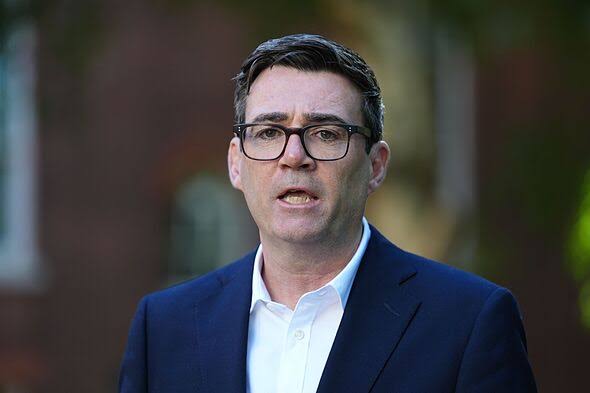
Andy Burnham ripped apart on Question Time for ‘attack on pensioners’ – ‘Indefensible!’. hyn

The Prime Minister has been accused of plotting to scrap “a lifeline for hundreds of thousands of pensioners around the country”.

Suella Braverman accused Andy Burnham of ‘attacking’ pensioners (Image: BBC)
Andy Burnham has been slammed for his “indefensible attack” on pensioners on BBC Question Time after proposing changes to the triple lock. The Prime Minister announced plans to change how pensions are increased during his speech at the Labour conference this week, with payments currently rising by the rate of inflation, earnings or 2.5%, whichever is highest.
From 2030, under the plans, the automatic link to average earnings would be scrapped, with pensions to increase by either 2.5% or the rate of inflation. The savings would be used to fund a national care service in England, but Reform MP Suella Braverman hit out at the plan on Thursday night’s Question Time, suggesting it could jeopardise a major source of “financial security for lower-income pensioners”.
Questioned by a member of the audience on whether the proposal is a “betrayal of older generations”, Ms Braverman said: “The short answer is yes. Andy Burnham’s attack on the triple lock is really indefensible. The triple lock provides a lifeline to hundreds of thousands of pensioners around the country.”

Andy Burnham announced the controversial plan in his Labour Conference speech (Image: Getty)
She added: “By attacking it, or modifying it, as Burnham is suggesting, they are cutting off that lifeline, and that’s not fair. These are people who will have worked for much of their lives, and now they’re being robbed of what they’re entitled to.”
The former Tory MP said there were “alternative” sources of funding for the national care service, including “scrapping our migrant welfare bill, foreign aid or net zero levies”. She also accused Labour of not being honest about the money needed to fund the “idealistic” care service, which Mr Burnham said would be covered by the £15billion annual sum raised by the pensions tweak.
The Institute for Fiscal Studies (IFS) warned following his speech that the savings would not be enough, and Culture Secretary Lisa Nandy appeared to acknowledge “additional funding” could be required in an interview with LBC.
Jonathan Cribb, deputy director of the IFS, said: “Savings are likely to be relatively small in the first few years but rise substantially over time. We should not expect this reform to save enough that it could fund universal social care in the next parliament.”
Mr Burnham refused to budge on his initial estimate in a Sky News interview on Wednesday, however, suggesting the savings “would be enough to pay for social care” but “obviously they’re not released immediately”.
He denied speculation that the shortfall would be plugged with tax rises, adding: “There’s a different way of doing it. If you delay the date of introduction and you introduce a national care service progressively, you could do it in a different way. You could do it earlier.”
Andy Burnham Ripped Apart on Question Time for ‘Attack on Pensioners’ – ‘Indefensible!’
Andy Burnham’s controversial plan to change the state pension triple lock has come under renewed pressure after a heated debate on BBC’s Question Time, where Reform MP Suella Braverman described the proposal as an “indefensible” attack on pensioners.
The confrontation highlighted one of the most politically sensitive elements of Burnham’s plans for government: how Britain should fund a new National Care Service while protecting the incomes of older people.
Under the current triple lock system, the state pension rises each year by whichever is highest of inflation, average earnings growth or 2.5 percent. Burnham has proposed changing that arrangement from 2030, removing the automatic earnings element so that pensions would instead rise by inflation or 2.5 percent, whichever is higher. The government says the resulting savings would help finance a National Care Service in England.
The proposal has triggered a fierce political argument over whether the reform represents a sustainable way of funding social care or whether pensioners are being asked to carry too much of the financial burden.
A heated Question Time exchange
The issue came to the forefront during the BBC’s Question Time programme on October 1, when an audience member asked whether changing the triple lock amounted to a betrayal of older generations.
Braverman responded that the answer was yes and described Burnham’s proposal as an “indefensible” attack on the triple lock.
She argued that the policy could threaten an important source of financial security for lower-income pensioners, particularly those who rely heavily on the state pension.
Her criticism reflected a wider argument from opponents of the proposal: pensioners have already planned their retirement around the existing system, and changing the rules could reduce the future growth of their income compared with what would happen under the current triple lock.
The exchange demonstrated why pension reform is such a difficult political issue.
For many older people, the state pension is not simply another government benefit. It is a central component of household income during retirement.
Any proposal to change the mechanism therefore attracts intense scrutiny.
What exactly is changing?
The triple lock was introduced to ensure that the state pension would not lose value relative to prices or average earnings.
Under the current system, pension increases are determined by three measures. The government chooses whichever produces the largest increase: inflation, average earnings growth or the 2.5 percent minimum.
Burnham’s proposal would remove average earnings as an automatic part of that calculation from 2030.
Instead, pensions would increase by whichever is higher between inflation and 2.5 percent.
The change does not mean that the state pension would be frozen. Nor does it mean that pensioners would necessarily receive smaller cash payments from one year to the next.
Rather, the policy would reduce the possibility of pensions rising faster than inflation when earnings growth is particularly strong.
That distinction is important because much of the political argument has focused on the long-term effect rather than an immediate reduction in pension payments.
The government’s case for reform
Burnham has presented the proposal as part of a much broader plan to reform social care.
His government wants to establish a National Care Service in England, with the aim of reducing the financial burden on people who require care.
Supporters argue that Britain’s existing social care system places considerable pressure on families. Some people can be forced to use their savings or other assets to pay for care, while local authorities face significant financial pressures.
The government argues that creating a national system could provide greater security and reduce pressure on the NHS.
The proposed pension change is intended to contribute towards the cost.
Burnham has indicated that the reform could eventually generate around £15 billion a year, although the precise timing and scale of the savings have become central to the controversy.
His argument is essentially that Britain cannot continue postponing the social-care problem indefinitely.
The government therefore believes that a long-term reform of pension increases could help create a more sustainable funding model.
Critics question the numbers
However, one of the most significant challenges to Burnham’s proposal has come not only from opposition politicians but also from independent economic analysis.
The Institute for Fiscal Studies has warned that the savings generated by changing the triple lock would be relatively small during the early years and increase substantially over time.
Jonathan Cribb, deputy director of the IFS, said the reform should not be expected to generate enough money to fund universal social care in the next Parliament.
That raises an important question about the government’s timetable.
If the pension reform does not generate the required amount of money immediately, the government would need another source of funding to establish the National Care Service before the full savings become available.
That could mean delaying some elements of the programme, introducing the service gradually or finding additional public funding.
The government has acknowledged that the reform’s financial benefits would build over time.
Burnham defends the plan
Despite the criticism, Burnham has defended his approach.
In a Sky News interview, he argued that the savings would ultimately be sufficient to help pay for social care, while acknowledging that the money would not become available immediately.
He also rejected suggestions that the gap would automatically have to be filled through tax increases.
Instead, he suggested that the government could introduce the National Care Service progressively or adjust the timetable so that expenditure matched the resources becoming available.
This is a crucial part of the government’s defence.
Burnham is not presenting the pension reform as an instant £15 billion windfall. Rather, the proposal is intended as part of a long-term restructuring of public spending.
Nevertheless, critics argue that the government must explain exactly how the system would be funded during the transition period.
Pensioners and the question of fairness
The most powerful argument against the reform is the question of fairness between generations.
Opponents say that pensioners should not be expected to finance a wider social-care reform simply because the government has difficulty finding another source of funding.
They argue that many pensioners have spent decades paying taxes and National Insurance and made financial decisions based on the retirement system that existed during their working lives.
From that perspective, changing the triple lock could be seen as changing the rules after people have already made their plans.
Supporters of reform take a different view.
They argue that the government has to consider the needs of both current pensioners and younger generations who will eventually depend on the state pension.
The cost of pensions is also affected by Britain’s ageing population.
As the number of older people increases relative to the working-age population, governments face difficult decisions about taxation, pension spending and public services.
That makes the debate about the triple lock much bigger than a single political announcement.
Alternatives have been proposed
Braverman argued during the Question Time debate that there were alternative ways of funding a National Care Service.
She pointed to areas including foreign aid, net-zero-related spending and what she described as the migrant welfare bill.
Those suggestions form part of a broader political argument over government priorities.
The government, however, would have to assess the actual savings available from each option and consider the wider consequences of reducing spending in those areas.
The debate therefore cannot be resolved simply by identifying another spending category.
Every alternative involves a trade-off.
Opposition parties seize on the controversy
Burnham’s proposal has also created an opportunity for his political opponents.
Conservative leader Kemi Badenoch has argued that the plan could make further tax rises necessary.
Reform leader Nigel Farage has also criticised the proposal, arguing that the government should not reduce the protection provided to British pensioners.
Their criticism reflects a wider political battle over who should bear the cost of social care.
The government wants to establish a major new public service, but funding such a service inevitably raises difficult questions.
Should the money come from general taxation? Should it come from changes to existing benefits? Should pension growth be reduced? Or should people contribute directly towards care?
There is no option without consequences.
Why the triple lock matters politically
The political sensitivity of the issue comes from the importance of the triple lock itself.
The policy has become closely associated with pensioner financial security. Even a reform that does not immediately reduce the state pension can generate concern because its effects accumulate over many years.
A change made in 2030 could therefore influence retirement incomes for decades.
That is why the government will need to explain the long-term consequences clearly.
Pensioners will want to know how their income will change. Younger workers will want to know whether the system will remain affordable when they retire. And taxpayers will want to know how much the proposed National Care Service will actually cost.
The Question Time confrontation demonstrated just how difficult it will be to satisfy all three groups.
The wider social-care challenge
Despite the controversy over pensions, there is relatively broad recognition that Britain’s social-care system faces serious challenges.
The disagreement is primarily over how the system should be reformed and paid for.
Burnham argues that the country needs a major change rather than another temporary solution.
His critics accept that social care needs attention but dispute whether changing the pension triple lock is the appropriate way to fund it.
That distinction is likely to remain central to the political debate.
A major test for Burnham
The triple-lock controversy could become one of the defining policy battles of Burnham’s government.
The Question Time exchange showed that opponents are prepared to frame the proposal as a direct threat to pensioner security, while the government wants to present it as part of a long-term plan to fix social care.
The financial evidence also means that the debate will not be settled by political rhetoric alone.
The government will have to demonstrate how much money the reform will raise, when those savings will become available and how the National Care Service will be financed before then.
At the same time, ministers will need to explain what the changes mean for different groups of pensioners.
The central question is ultimately one of priorities.
Britain faces growing pressure to improve social care, but it also has a large population of pensioners who depend on state support.
Burnham’s proposal attempts to address both issues simultaneously.
The fierce reaction on Question Time shows why that attempt has become so contentious.
Whether the policy is ultimately judged as a necessary reform or an unacceptable reduction in pension protection will depend heavily on its final design, the evidence surrounding its finances and the government’s ability to demonstrate that the National Care Service can deliver meaningful benefits.
For now, however, one thing is clear: the battle over the triple lock has only just begun, and pensioners are likely to remain at the centre of Britain’s political debate over public spending, social care and intergenerational fairness.