
 Reform breaks new ground west of the border in huge boost for Nigel Farage’s party as elections loom
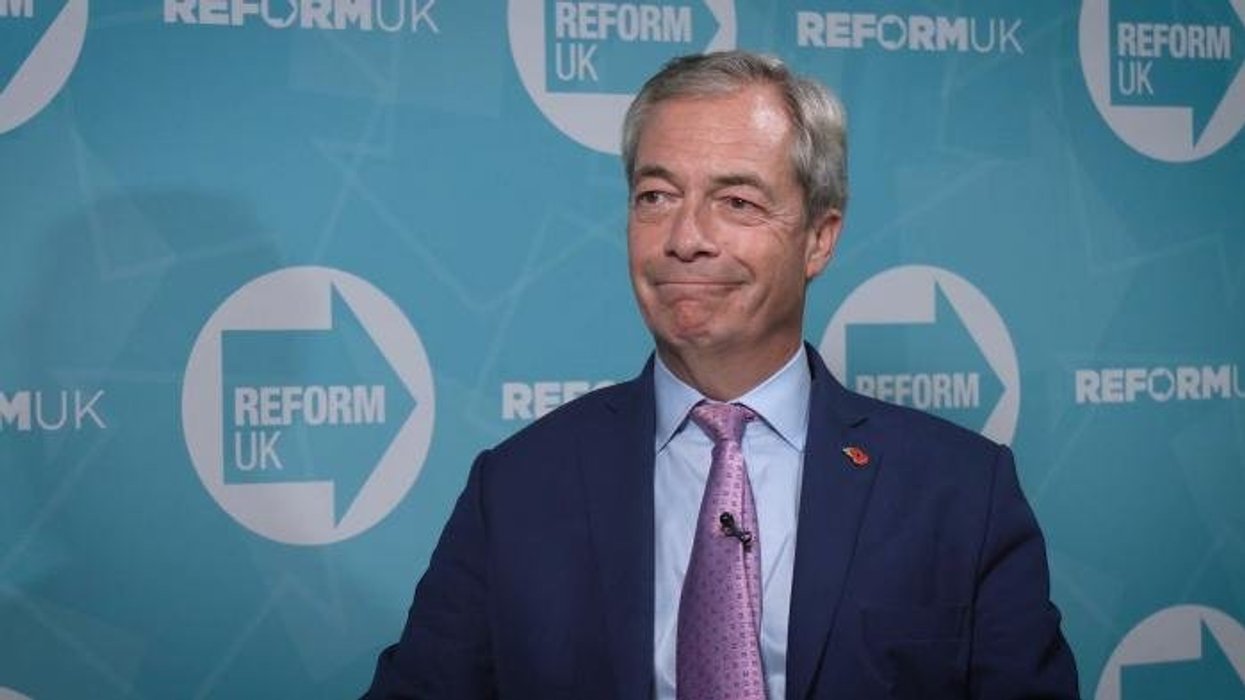
Scott Thorley has become the first councillor for Nigel Farage’s party in Pembrokeshire
Reform UK has won its first councillor on a Welsh council as the party looks to make gains in this year’s Senedd elections.
The by-election was called after the death of outspoken former councillor Mike Stoddart.
GB News has dissected the result and what it could mean for the major parties going forward into the Welsh Parliament election.
Milford Hakin (Pembrokeshire)
This week’s sole council by-election was held after the death of local journalist turned Councillor, Mike Stoddart.
The by-election made headlines after the Welsh Labour candidate, Nicola Harteveld, withdrew from the contest after her teenage son was verbally abused by two strangers.
Reform UK’s Scott Thorley won the by-election in the ward, with 179 votes, with Welsh Conservative Party Kelvin Taylor in second place on 144 votes.

Reform UK’s Scott Thorley came out on top
Samuel Warden from the Welsh Liberal Democrats was in fifth on 57 votes, with Ms Harteveld still attracting 27 votes for Welsh Labour despite her suspending all campaigning. Independent Derrick Abbott came in last on 11 votes.
A total of 661 votes were cast, with the turnout at 32.7 per cent.
Plaid Cymru did not field a candidate.
It was not the first time Mr Thorley had stood as a candidate for Nigel Farage’s party in Pembrokeshire.
Mr Thorley previously stood in the Prendergast Haverfordwest ward, which was won by Independent Alun Wills, with the Reform candidate finishing in fourth.
Speaking after his victory, Mr Thorley told The Tenby Observer: “It was a massive honour to win last night and I’m more than aware I’ve got some massive shoes to fill in Hakin.
Reform UK’s candidate in the Caerphilly by-election, Llyr Powell, said: “Voters want change, and Reform UK is ready to deliver it. Vote Reform. Get Reform.
The bulk of Pembrokeshire County Council is made up of independent councillors, with 34 out of the 60 elected not affiliated to any party.
Out of the 34, 19 sit together as the “Independent Group”.
There are 11 Welsh Conservative councillors, nine from Welsh Labour, three from Plaid Cymru and two Liberal Democrats.
Mr Thorley has become the first Reform UK councillor on the ward
SHOCK WIN: Reform Storms By-Election in Huge Boost for Farage
Reform UK has delivered another striking electoral result, giving Nigel Farage fresh ammunition as the party attempts to turn its growing support into a sustained challenge to Britain’s established political parties.
The latest by-election result has put the spotlight firmly back on Reform’s ability to win votes in constituencies where traditional party loyalties have weakened and where frustration over immigration, living standards and the direction of the country remains high.
For Farage, every successful by-election is more than a single parliamentary contest.
It provides an opportunity to argue that Reform is no longer simply a protest movement but a serious force in British politics.
That argument has gained additional attention following Reform’s victory in the Clacton by-election in August, when Farage secured 63 per cent of the vote and was returned to Parliament with 22,239 votes.
The result was particularly significant because Farage himself had triggered the contest after resigning his seat.
He presented the election as a direct test of his leadership and of Reform’s wider appeal.
The result gave him a substantial majority and allowed him to claim that voters had delivered a message to Westminster.
Since then, the party has attempted to maintain momentum while expanding its organisation and preparing for the next general election.
But the road has not been entirely straightforward.
Reform has also experienced defeats in parliamentary and local by-elections, demonstrating that its support is not uniform across Britain.
The Makerfield by-election in June was a particularly important example.
Andy Burnham won the seat for Labour with 54.8 per cent of the vote, while Reform candidate Robert Kenyon finished second with 34.5 per cent.
Farage subsequently admitted he was disappointed with Reform’s vote share and appealed directly to supporters who had backed rival right-wing group Restore Britain.
That contest demonstrated both the potential and the difficulty facing Reform.
The party can attract a large share of the vote, but a divided field on the right can prevent it from converting that support into seats.
That makes every subsequent victory politically important.
A successful Reform campaign allows Farage to argue that voters are prepared to move beyond the traditional Labour-Conservative contest.
It also gives the party greater confidence as it develops its nationwide organisation.
The political environment has changed significantly since the 2024 general election.
Labour remains the governing party, but Reform has established itself as a major electoral force.
The Conservatives, meanwhile, are attempting to rebuild after their historic defeat.
That leaves Reform competing not only against Labour but also against a Conservative Party seeking to win back voters who have moved towards Farage.
There is also growing competition from smaller parties and newer political organisations.
The emergence of Restore Britain has created particular complications for Reform in some constituencies.
The issue became visible during the Makerfield contest, where Reform received 34.5 per cent and Restore received 6.8 per cent.
Combined, the two parties attracted 41.3 per cent, but Labour still won the seat comfortably.
More recently, local by-election results have provided another reminder that Reform cannot assume victory simply because it has performed strongly in national polling or previous elections.
On October 2, Labour gained two council seats from Reform in Northumberland, while Reform also suffered setbacks elsewhere.
The mixed record makes the latest Reform success particularly valuable for Farage.
It allows the party to emphasise the contests where its support has translated into actual victories rather than merely strong vote shares.
And that distinction matters enormously in Westminster politics.
Winning votes is one thing.
Winning seats is another.
The British electoral system rewards parties that can concentrate support effectively across constituencies.
Reform’s challenge is therefore to turn its national appeal into a broad geographic coalition.
Farage has increasingly focused on areas where voters who previously supported Labour or the Conservatives may be willing to switch.
Immigration is central to that strategy.
Reform has made opposition to high levels of immigration and tougher border controls major elements of its political message.
But the party is also attempting to broaden its appeal through policies on taxation, public services, education and the economy.
The aim is to convince voters that Reform can govern rather than simply protest.
That ambition is now being tested against the reality of running a national political organisation.
Recent controversies surrounding Reform have also provided ammunition for opponents.
The party has faced scrutiny over donations, internal disputes and the conduct of some senior figures.
Farage himself remains under parliamentary scrutiny over a £5 million gift from cryptocurrency investor Christopher Harborne, which he says was used for security. The issue remains contested and should not be confused with a finding of wrongdoing.
At the same time, Reform has sought to project a more professional image.
Farage has spoken about building a stronger national campaign machine and has increasingly presented the party as an alternative government rather than simply an insurgent movement.
The timing is important.
Prime Minister Andy Burnham has also attempted to reset Labour’s political strategy since taking office.
His government is trying to establish a new economic agenda, increase investment in regions and address long-standing concerns over public services.
But Burnham’s decision to reopen the debate over Britain’s relationship with the European Union has given Farage another political opening.
Farage has described Burnham’s comments on Brexit as a major boost for Reform, arguing that the Government risks reopening an issue that remains highly contentious.
That confrontation could become increasingly important.
For Reform, Brexit is not simply a historical issue.
It remains part of the party’s political identity and a central component of Farage’s personal political legacy.
Any suggestion that Britain could move towards closer integration with the EU provides Reform with an opportunity to argue that the Government is attempting to reverse the result of the 2016 referendum.
Labour, however, argues that it is possible to improve Britain’s relationship with European countries without simply reversing Brexit.
That disagreement is likely to continue.
The latest by-election success therefore comes at a moment when Reform is attempting to define precisely what it stands for in the next phase of British politics.
The party can no longer rely solely on opposition to Labour.
It has to persuade voters that it has credible answers to questions about economic growth, the NHS, housing, taxation, energy, crime and public services.
That is the difficult transition from protest party to potential governing party.
Farage himself has repeatedly argued that Reform is ready for a general election.
But by-elections provide only snapshots of public opinion.
They can be heavily influenced by local personalities, turnout, tactical voting and the particular circumstances surrounding a vacant seat.
The Institute for Government has highlighted how different the recent contests have been.
Since the 2024 general election, by-election winners have included Reform, Labour, the Greens, Conservatives and SNP, underlining how variable individual contests can be.
That means one result cannot by itself demonstrate that the entire country has moved in one direction.
Nevertheless, victories matter.
They provide momentum, publicity and organisational experience.
They also give candidates and activists confidence that campaigning can deliver tangible results.
For Farage, perhaps the most important consequence is the ability to keep Reform at the centre of the political conversation.
Every victory generates headlines.
Every strong second-place finish provides another argument that the party is competitive.
And every defeat exposes the areas where Reform still has work to do.
That combination will shape the party’s strategy over the coming months.
The Conservatives will be watching closely.
Labour will be watching closely.
And so will voters who are considering whether Reform is simply a vehicle for dissatisfaction or something capable of becoming a permanent part of Britain’s political establishment.
Farage’s response has been clear: he wants Reform to be treated as a government-in-waiting.
The latest electoral success gives him another opportunity to make that case.
But the real test will come when the party has to reproduce its performance across dozens, and potentially hundreds, of constituencies.
For now, however, Reform can point to another result and claim that its political breakthrough is not disappearing.
The party has experienced setbacks, internal disputes and intense scrutiny.
Yet it continues to win significant numbers of votes and, in the contests where its support is concentrated effectively, parliamentary seats.
That is why every by-election has become part of a much bigger story.
For Nigel Farage, the objective is no longer simply to win one constituency.
It is to turn Reform’s electoral breakthroughs into a nationwide political force.
Whether that ambition can ultimately be achieved will depend on far more than a single by-election.
But the latest result has ensured that Reform — and Farage himself — remain impossible to ignore.