
It began with a worried phone call — the kind that makes dispatchers straighten in their seats and officers brace for something dangerous.

“A raccoon,” the caller said.
“He’s acting strange. Might be rabid.”
In most cases, that kind of report means trouble. Fear. A scramble for safety.
But this time in Lakeville, Minnesota, the danger everyone expected never arrived.
Instead, something else showed up. Something softer. Something funny, heartwarming, and entirely unexpected.
A young raccoon — small, bright-eyed, and absolutely convinced that every human he met was a new friend.
What the Officers Found
When two officers pulled up to the scene, they were prepared for the worst: erratic behavior, aggression, or the unmistakable symptoms of rabies.
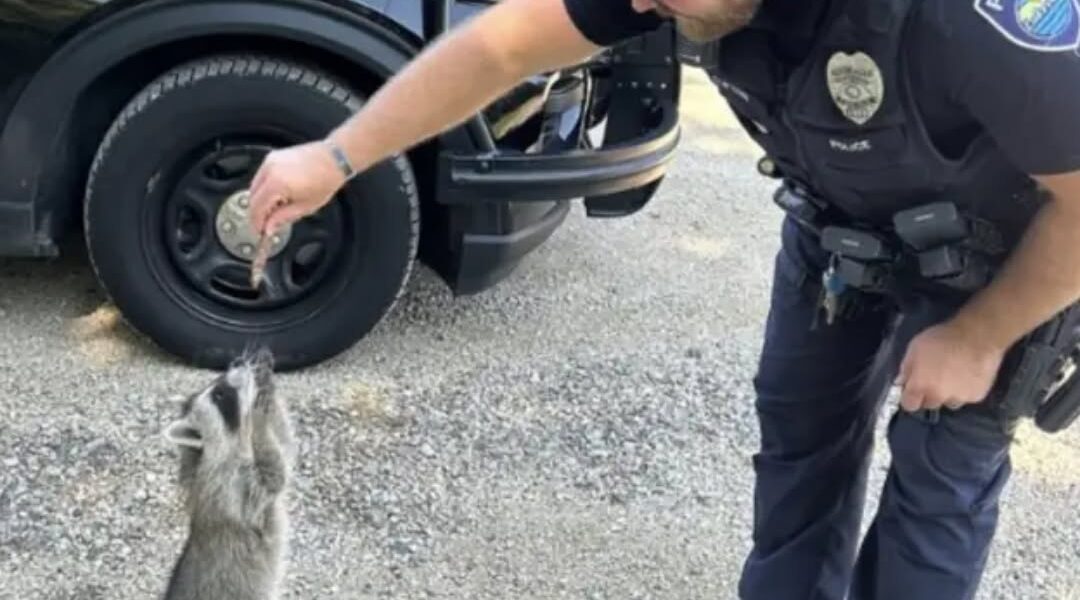
What they found instead was… a raccoon trotting toward them like an overly enthusiastic puppy.
“He was super friendly and dog-like,” a police spokesperson said later.
“He wanted to be around people.”
No snarling.
No fear.
No threat.
Just a little animal who saw two humans step out of a car and thought, Finally! Company.
A “Threat” Who Wanted Belly Rubs

From the moment they stepped out of the squad car, the officers had a new shadow. The raccoon — later named Gerald — followed them closely, sniffing their feet, trying to climb their legs, and occasionally sitting down beside them as if waiting for instructions.
“The officers quickly established a positive relationship with him,” the department shared.
He wasn’t sick.
He wasn’t aggressive.
He wasn’t afraid.
He was lonely.
And so he stuck to them like glue.
One officer bent down to examine him more closely, and Gerald responded by leaning in, almost nuzzling. Another officer tried to walk a few steps away to set up a safety perimeter, but Gerald scampered right after him, determined not to be left behind.
The officers kept exchanging looks — the kind only people who love their jobs and love animals understand.
This call was supposed to be about danger.
Instead, it turned into unexpected affection.

He Wanted to Go Home — Just Not to the Wild
Once they determined that Gerald wasn’t rabid, the next step seemed straightforward: relocate him to a nearby park where he could be safe and free.
But Gerald had other plans.
“He followed them around and wanted to go back to the squad car,” the spokesperson said.
Every time the officers took a few steps toward the woods, Gerald took a few steps toward the cruiser. When they gently shooed him in the other direction, he circled right back. And when they opened the squad car door to grab equipment, he tried to climb inside as if saying:
I choose this home. This one. Right here.
That’s when the officers realized what had likely happened.
Gerald wasn’t wild in the way they thought.
He might have been raised around humans.
He might have been fed by someone.
He might have been someone’s pet — even though keeping raccoons as pets is prohibited in Minnesota.
Whatever his story, one thing was obvious:
He didn’t want to be alone.

A Detour for His Safety
Because raccoons can’t legally be kept as pets, and because Gerald clearly didn’t understand the danger of being too trusting with humans, the officers made a careful decision.
They brought him to a wildlife rehabilitation clinic.
There, experts could make sure he truly didn’t have rabies, monitor his health, and — maybe the hardest part — help him learn to fear humans just enough to stay safe in the wild.
It’s bittersweet when an animal loves people too much.
Because out in the world, that kindness can hurt him.
But in the clinic, he’d get the training and care he needed to someday return to the forest with instincts strong enough to survive.
A Little Raccoon With a Big Impact
For such a tiny creature, Gerald made a huge impression.
By the end of the day, everyone at the police station was talking about him.
He made people smile.
He softened a stressful shift.
He turned a “rabid animal” call into something unforgettable.
“He is being talked about by everyone here at the office!” the spokesperson said with a laugh.
It’s rare — incredibly rare — that an emergency call ends with officers laughing, petting a raccoon, and trying to keep him from climbing into their cruiser for a ride-along.
But Gerald wasn’t just any raccoon.
He was a reminder.
A reminder that kindness exists in unexpected forms.
That not every strange behavior comes from danger — sometimes it comes from longing.
That even the most misunderstood creatures can surprise us with innocence.
And that sometimes, the softest stories arrive on days when you least expect them.
A Future That Looks Brighter Than His Past
At the rehab facility, Gerald is learning what it means to be a raccoon — not a shadow to humans, not a pet, but a creature capable of thriving in the wild.
He’s being cared for, watched over, guided, and protected.
If all goes well, someday he’ll be released back into the forest — wiser, more cautious, but hopefully still carrying a spark of the sweetness that made everyone fall in love with him.
And if the police officers who found him ever wonder whether he remembers them… maybe he will.
Maybe he’ll think of them when he sees a patrol car.
Maybe he’ll think of them when he finds a human scent on the wind.
Maybe he’ll remember the day when he wasn’t feared or rejected — only welcomed.
Whatever his story becomes, one thing is certain:
There was never a “rabid raccoon.”
Just a clingy little soul named Gerald who didn’t want to be alone.